2026-11-24
An Honest Look at Retreatment Root Canal Treatment That Even Patients and Dentists Often Don't Fully Understand #ToothSaving #DrChoiYonghoon
An honest look at retreatment root canal treatment, including its success rates, common causes of failure such as cracks and perforations, and when implants may be a better option.
Over my many years of treating patients, I have learned certain facts and figured out certain treatment methods the hard way.
When I share these on YouTube and my blog, there are three reactions I hope for:
'Wow, this is really great information. I should try it myself.'
'Well, I already know all of this. Nothing special.'
'He's way behind me. Dr. Choi will take a long time to catch up to my level.'
I don't watch other YouTube channels or blogs, and I especially don't interact much with dentists in Korea.
I'm very interested in overseas treatment cases, especially treatment trends in developed countries.
Developed countries are moving toward avoiding root canal treatment and crowns whenever possible.
I'm not being sycophantic just because they're developed countries.
As people live longer, the paradigm of dental treatment is changing.
For reference, South Korea is aging faster than any other country in the world.
In any case, my blog is like a diary where I record my own thoughts and notes.
If you find it helpful, apply it to your own situation as you see fit.
Otherwise, just go about your business as usual.
But someone reported it to the public health center and filed a complaint calling me a bad guy,
and a huge number of my YouTube videos have already been taken down.
My blog is constantly being reported.
I honestly don't know who gets hurt by my disclosing the materials and instruments I use.
Anyway, the reports keep coming in, and honestly, it's pathetic.
Some dentists who read today's post may get furious and hit their panic buttons.
And I think there will also be dentists who realize, 'Oh, so this is something I didn't know!'
What I want is this: if you've been undergoing retreatment for a long time with no improvement,
at least learn the cause here.
Back when Korea was a medically underdeveloped country, children sometimes died young for reasons no one could understand.
Their parents would bring their already lifeless child to the hospital
and beg, 'Please at least tell us what the illness is.' Such sad memories existed all the way up to our parents' and grandparents' generations.
Of course, it would be wonderful if retreatment went smoothly and easily.
But in real clinical practice, retreatment is the kind of treatment where, in my experience, even a 50% success rate feels like a good result.
You may think I'm exaggerating,
but overseas papers written by the world's top experts put the success rate of retreatment at around 80%.
Please keep in mind that these are people who have made their living doing nothing but retreatment for their entire careers,
and they charge well over 2 million won for root canal treatment alone.
Yesterday, a patient from Singapore came to see me because they felt uneasy about the root canal treatment they had received there, which had cost them 1.5 million won.
I don't even want to talk about how much root canal treatment costs in Korea anymore.
Anyway, as long as retreatment succeeds, that's all that matters.
Dentist's skill + patient's luck = success of retreatment.
Simple, right?
The problem is when symptoms don't improve even after a long period of retreatment,
or when they improve somewhat but there's still some pain or a strange feeling.
The most common reason is the inherent limitations of retreatment itself.
The longer you do root canal treatment,
the greater the chance that instruments will slip out of the tooth,
and the greater the chance that various medicaments will leak out of the tooth.
Think of it like golf: the more you swing, the more good shots you hit, but also the more mishits. It's exactly the same.
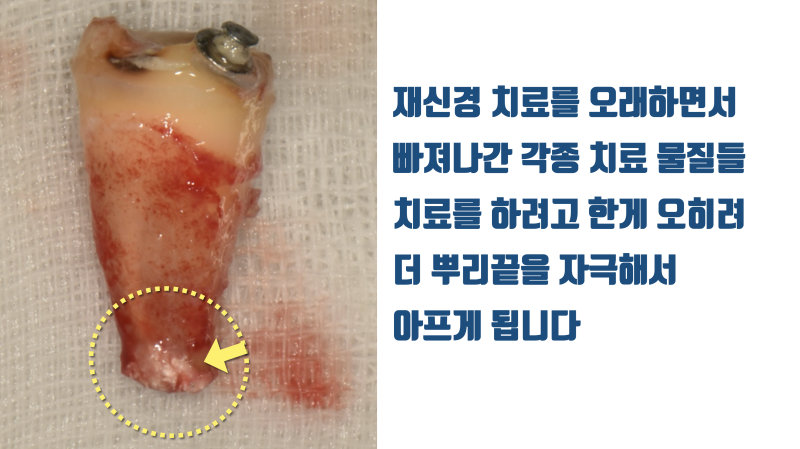
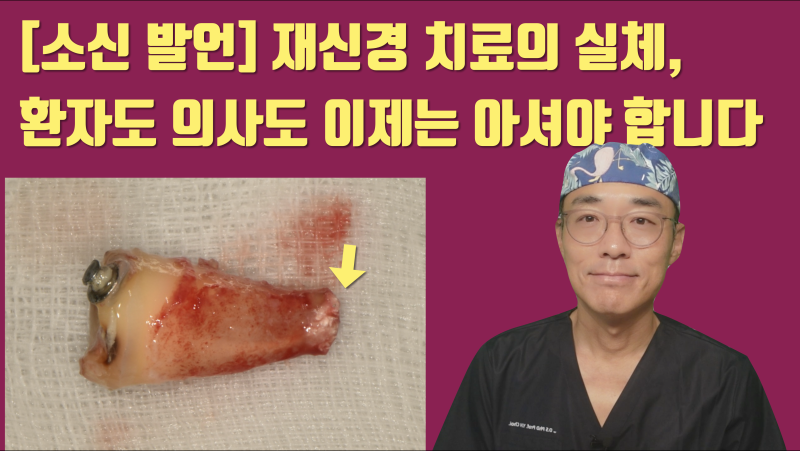
The photo below is a good example.
After months of retreatment, various medicaments have leaked out of the tooth,
and instruments must have gone in and out countless times. None of this can be seen with the naked eye.
No matter how much treatment you do, the substances that have leaked out like this don't get resolved. Instead, they just keep piling up.
It's like a clogged drain: the more water you pour into it, the more it gets blocked and the harder it is to fix.
That's why I tell people to finish root canal treatment and retreatment as quickly and definitively as possible, and then wait for the results.
But that's not the end of it.
[Reasons Retreatment Fails]
Cracks
Perforation
Periodontal disease
Deep caries
Fractured instruments that cannot be removed
6. Root canals blocked by spontaneous calcification
Even when you can assume none of these are present, retreatment is still a borderline call.
Unfortunately, cracks are far more common than you might imagine.
If any dentists have read this far, know that cracks must always be found at the very beginning and disclosed to the patient.
A crack is not the dentist's fault.
But if you keep doing retreatment on a tooth that won't resolve because of a crack, without thinking,
and the results still aren't good after several rounds of treatment,
only then do you tell the patient,
'I'm afraid this tooth probably won't respond well because of a crack.'
Would anyone calmly accept that?
Or would they say, 'Didn't this crack happen while you were treating it, Doctor?'
Before going to the public health center to file a report, please think carefully with a cool head.
If someone teaches you something, you can learn from it. But filing reports with a hot heart won't change anything.
While working at a university hospital, I saw many cases where private clinics nearly shut down because of cracks,
and I myself have suffered terribly, body and mind, because of cracks.
Assuming none of the six factors I mentioned above are present at all,
retreatment is still a borderline call, even if you do your very best.
It's good for both patients and dentists to approach treatment with hope.
But you need to accurately assess the current situation, and when something isn't working, find out why.
If working on it blindly for a long time with great effort would produce good results,
then my classmate in high school, who bought every workbook sold at the bookstore and was always the last one still sitting during evening self-study, would have gotten into Seoul National University as the top student.
I'm not saying retreatment always fails, so don't do it.
There are simply too many variables and risk factors, so you need to make an accurate judgment before treatment,
and then act quickly and with focus to get it done properly, and wait for the results.
Personally, because I see so many absurd cases of teeth in Korea,
I hardly ever touch anything except the root canal treatments I have done myself.
If anyone reading this post is planning retreatment,
it's best to go back to the dentist who did your first root canal, or to a professor who specializes in retreatment in the Department of Conservative Dentistry at a university hospital.
My specialty is opening up teeth where retreatment has failed, examining them, and resolving every problem that has developed inside.
That's because I've seen so many problems and limitations with retreatment.
Implants are a good alternative too. I mean it.
If you spend months struggling over a single tooth, getting poor results and still clinging to it, both patients and dentists should each judge for themselves whether this is the right path.
There are countless reasons why retreatment in Korea has so many limitations.
If you go through my posts, you'll see how serious the condition of Koreans' teeth is, how severe the internal contamination can be,
and how many cracks there are.
I have a lot to say about why the level of root canal treatment in Korea is low,
but when I talk about the structural problems, people don't listen with a cool head.
Those who charge in at the first whistle, hit the panic button, and lash out aren't scary to me, but I don't want to deal with them, so I'll leave it out here.
Anyway,
The longer you do root canal treatment, the higher the chance of mistakes!
Instruments or materials slipping out of the tooth is bad, and it's also hard to fix!
Doing root canal treatment without preparing for cracks, perforations, periodontal disease, and so on is completely pointless.
Just for saying this simple truth, which even laypeople can understand if they think about it for a moment,
people report me to the public health center and gather in KakaoTalk group chats to hurl insults at me. It's so disheartening that I'll stop here.
That's all.
In Korea, implants are considered the default treatment.
Saving a tooth is not a simple or easy treatment.
Also, once a tooth crosses a certain threshold, it can't be saved.
Losing multiple teeth or having multiple loose teeth makes the tooth-saving treatment I do difficult.
I'd recommend watching my blog and YouTube videos thoroughly and checking whether you fall into this category.
Dr. Choi Yong-hoon's clinic introduction video: https://www.youtube.com/watch?v=YCiCJLrG1J8
#CrackedTooth #RetreatmentRootCanal #RootCanalTreatment #Replantation #ToothReplantation #FracturedToothReplantation #PeriodontalReplantation #DrChoiYonghoon #ToothSaving
Frequently Asked Questions
What is the success rate of retreatment root canal treatment?
The author cites overseas papers reporting a retreatment success rate of around 80%. The author also describes it, based on clinical experience, as a treatment where even a 50% success rate feels like a good outcome.
Why does retreatment fail?
The author lists cracks, perforations, periodontal disease, deep caries, fractured instruments that cannot be removed, and spontaneously calcified root canals as causes of retreatment failure. The author notes that cracks are far more common than one might imagine.
What problems come with prolonged root canal treatment?
According to the author, the longer root canal treatment goes on, the greater the chance that instruments or medicaments will pass out of the tooth, and the higher the likelihood of errors. The author explains that substances that have leaked out of the tooth are not easy to resolve.
Where should I go if I'm considering retreatment?
The author recommends going back to the dentist who performed the first root canal, or to a retreatment specialist professor in the Department of Conservative Dentistry at a university hospital, if you are planning retreatment. The author stresses accurately assessing your current situation before treatment.
Can implants be an alternative to retreatment?
The author says implants are also a good alternative. However, if you have spent months struggling over a single tooth with poor results, the author suggests that patients and dentists each judge whether this direction is the right one.
Is tooth saving possible in every case?
No, tooth saving is not possible in every case. The author explains that once a tooth crosses a certain threshold, it can't be saved, and that losing multiple teeth or having multiple loose teeth makes it difficult.