2026-11-16
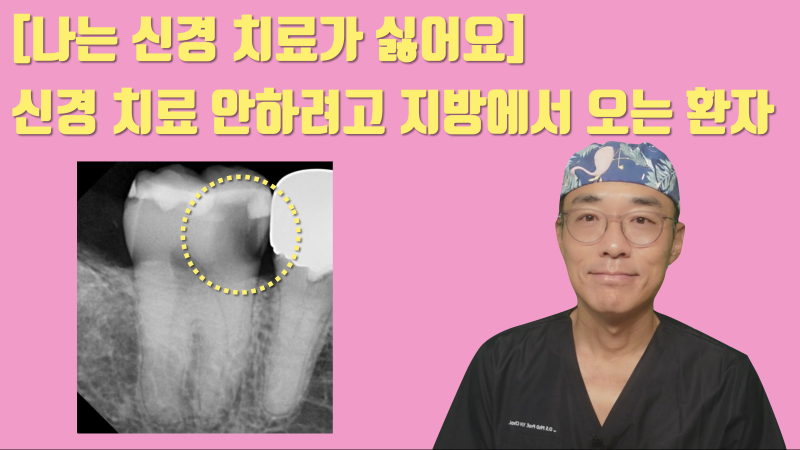
[I Don't Like Root Canal Treatment] Patient Who Came from Out of Town to Avoid Root Canal Treatment #ToothPreservation #DrChoiYonghun
A Pangyo dentist explains why root canal treatment should be avoided when possible, how pulpitis is judged, and a patient case of nerve preservation instead of a crown.
I sincerely hope this post reaches the people who truly need it through Naver's algorithm and AI.
Personally, I think I'm guilty (?) of making a big splash in Korea's root canal field with single-visit root canal treatment,
and as a result, many dentists strongly dislike me.
The strange thing is that in the United States, root canal treatment is officially recommended to be completed in one to two visits,
and it's even in the textbooks. But when I started doing single-visit root canal treatment,
I was subjected to all kinds of threats and hostility from various academic societies and organizations.
I just chalked it up to being ahead of my time, and now I don't talk about root canal treatment at all.
It's like people who pack their lunch and go around insisting that you must drive a gasoline car and that driving an electric car is wrong,
forming cliques and insisting that only they are right.
They claim that everything outside their own methods is wrong, wasting precious energy on it
and I personally think it's a shame to spend an entire lifetime like that.
If something better comes along that's better for patients and for themselves, they should accept it,
or if their own methods are better, they can just keep going their own way.
But they go around loudly calling others wrong just because they're different from them,
much like existing car company employees protesting in front of a Tesla showroom, telling people not to buy electric cars.
I, too, am always ready to switch if my approach turns out to be wrong or if something better comes along.
Since opening my own private clinic, I've been able to freely use materials that were hard to get at university hospitals,
and my approaches to replantation and tooth transplantation have changed dramatically.
That's exactly why I openly tell people not to read the books I've written.
All of my treatment instruments have been updated, and in particular, the tooth storage solutions and the materials that improve the periodontal ligament
are things I honestly never even got to see when I was a university hospital professor, but now I use them every day.
At this point, you might ask, 'Aren't university hospitals the best?'
University hospitals do have the advantage of being able to boldly invest in expensive equipment and facilities,
but the downside is that bringing in instruments or materials used by a single dental clinic can take more than a year,
and if there's no profitability, adoption can be outright rejected.
If you've worked for a company, you'll understand this well.
No company buys everything that an unprofitable department asks for.
And even when they do buy, the process is very strict and difficult. That's only natural.
It's hot out and I'm under a lot of stress, so this post is wandering off track...
Just as patients dislike it, I dislike root canal treatment too.
I always say this: if you can avoid root canal treatment, avoiding it is best.
To extend the lifespan of a tooth, you should delay root canal treatment as much as possible.
More than 90% of the teeth I save are teeth that have already undergone root canal treatment.
Single-visit root canal treatment is good, but even better is treatment that preserves the original nerve without doing root canal therapy at all.
Saving both the tooth and the nerve.
Oh, that's a good way to put it.
Anyway,
For deep cavities, I run various tests
and if it's reversible pulpitis, I try nerve-preserving treatment.
Irreversible pulpitis is a no-go.
Irreversible pulpitis is when the pain triggered by cold water is severe and the pain persists.
The toothache you never want to go through again is irreversible pulpitis.
Once it's irreversible pulpitis, root canal treatment is absolutely necessary.
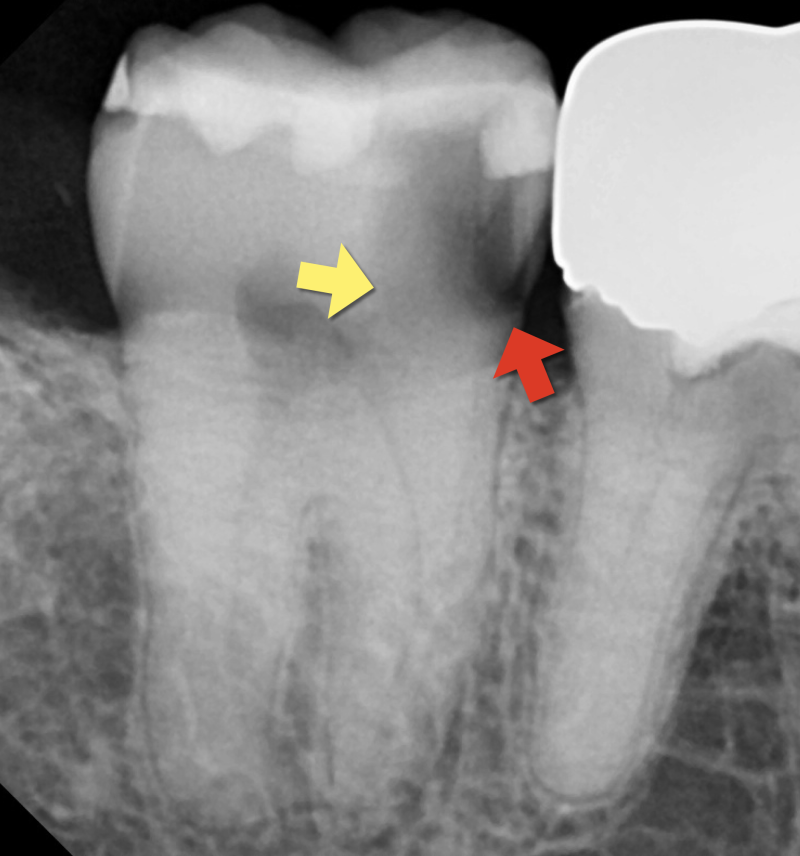
This patient came up from out of town, and based on X-rays, there's a much higher likelihood that root canal treatment would be needed.
If you follow the yellow arrow, the nerve is almost 100% exposed.
On top of that, the red area is also a problem, because the decay extends down to the level of the alveolar bone,
and if this area isn't cleanly finished, bacteria will get in and root canal treatment will end up being necessary anyway.
Thankfully, it's not irreversible pulpitis yet, so I focus on good nerve protection treatment and monitor the progress.
If the tooth doesn't feel sensitive to cold, or if it does but the sensitivity is mild or fades quickly, I consider the nerve protection to have gone well,
and I bond a ceramic restoration. Even when nerve protection has gone well, I still feel uneasy, so
I bond the ceramic very carefully to create a double layer of nerve protection.
Many people still go around asking whether this material or that one is better,
but think of it like paint: no matter how good the paint is, there's a big difference between what one painter creates and what I create.
What matters is making the best use of each material's properties and doing the work well.
Above all, the most important thing is to accurately determine whether a tooth is reversible or irreversible, and to do well the treatment that is truly necessary.
If a material existed that could heal teeth just because it's good, I'd be the first to get it, no matter how expensive.
No such material exists.
This patient had been told at several places that they needed root canal treatment plus a crown,
but since they no longer wanted crown treatment, they came to see me,
and thankfully, they're now using the tooth well, without any pain.
You might ask, 'What if it doesn't work?'
I do my best to avoid root canal treatment, and if that still doesn't work,
that's when root canal treatment can be done.
That's all.
In Korea, implants are the default treatment.
Saving teeth is not an easy or simple treatment.
Also, once a tooth crosses a certain threshold, it can no longer be saved.
Cases involving multiple missing teeth or multiple loose teeth are difficult to treat with the tooth-saving approach I practice.
I'd recommend reading through my blog and watching my YouTube videos to see whether you fall into this category.
Dr. Choi Yong-hun clinic introduction video: https://www.youtube.com/watch?v=YCiCJLrG1J8
#PainlessDentalAnesthesia #PainlessAnesthesia #PeriodontalLigamentAnesthesia #CrackedTooth #Replantation #ToothReplantation #FracturedToothReplantation #PeriodontalDiseaseReplantation #DrChoiYonghun #ToothPreservation
Frequently Asked Questions
Which type of pulpitis requires root canal treatment?
Irreversible pulpitis requires root canal treatment. Irreversible pulpitis refers to cases where pain caused by cold water is very severe and persists, while if the pulpitis is reversible, nerve-preserving treatment can be tried first.
Is tooth-saving treatment possible for every tooth?
No, it's not possible for every tooth. Once a tooth passes a certain threshold, it can no longer be saved, and tooth-saving treatment is considered difficult when multiple teeth are missing or multiple teeth are loose.
Is it better to avoid root canal treatment if you can?
Yes. The post explains that avoiding root canal treatment whenever possible is best. It notes that delaying root canal treatment as much as possible helps extend the tooth's lifespan, and states that treatment that preserves the original nerve is better than single-visit root canal treatment.
What's the case of a patient who visited from out of town?
This is the case of a patient who came up from out of town. After being told at several clinics that they needed root canal treatment and a crown, they didn't want crown treatment and visited instead. Since it wasn't yet irreversible pulpitis, nerve protection treatment was performed, and if cold sensitivity was mild or faded quickly, a ceramic restoration was bonded.
Does good material make treatment happen on its own?
No, treatment doesn't happen on its own just because of the material. The post stresses that what matters is making good use of a material's properties and accurately determining whether a tooth is reversible or irreversible so that only the necessary treatment is performed.