2026-11-17
[Root-End Surgery, Done with Fulfillment] Why I Keep Doing Root-End Surgery Even After Swearing I'd Never Do It Again #RootEndSurgery #Apicoectomy #DrChoiYonghun
Dr. Choi Yong-hun explains why he keeps performing root-end surgery despite swearing never to do it again, covering its benefits, difficulty, and treatment priorities.
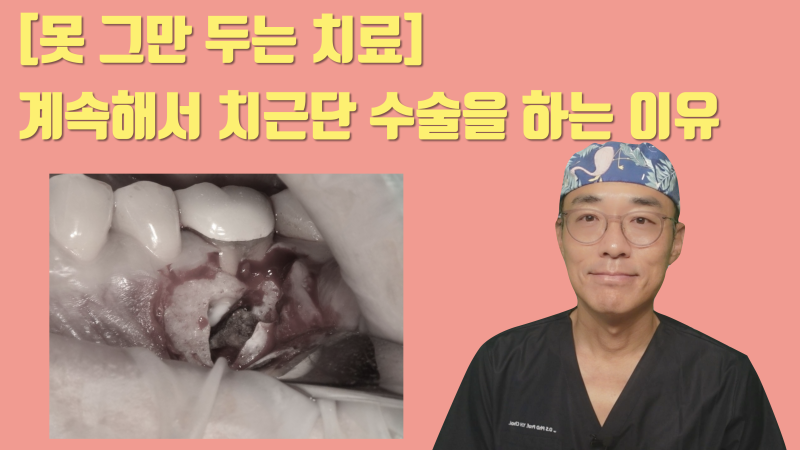
Among all tooth-saving treatments, none is easy, and this is the hardest of them.
Especially with molar root-end surgery, I catch myself sighing every time, without even realizing it.
I swear to myself, "This is the last one, I'll never do it again!"
But once it's over and I look at the white dot (which I'll explain below),
my resolve starts to waver(?). It's a strange kind of tooth-saving root-end surgery.
The root-end surgery I perform uses a different approach.
Root-end surgery has a high failure rate, especially a high recurrence rate,
and with molars, access itself is often difficult,
so I use the method I believe has the lowest recurrence rate,
and I apply various techniques to prevent inflammation from recurring and to promote alveolar bone regeneration.
Of all these, the most important thing is
to thoroughly clean the contaminated root and create the necessary space,
and then seal it completely so that it never recurs.
But this is easier said than done.
The further back the tooth, the more I have to bend my head all the way down and go in,
and it's almost like doing a headstand just to see anything.
My method cannot tolerate even the slightest bleeding,
and keeping the surgical site completely free of blood is not as simple as it sounds.
The material I use is extremely sensitive to moisture,
so even a little bleeding immediately causes the material to degrade, and the procedure fails.
There are multiple steps just in preparing the material and pretreating the tooth,
so if bleeding contaminates the field at the very last moment, when I place the final white dot (the finishing touch),
I have no choice but to swallow my tears and start over from the beginning.
The staff's sighs (they don't actually make a sound!) ring in my ears,
and most of all, I myself am on the verge of losing my composure,
but I pull myself together and place the white dot again.
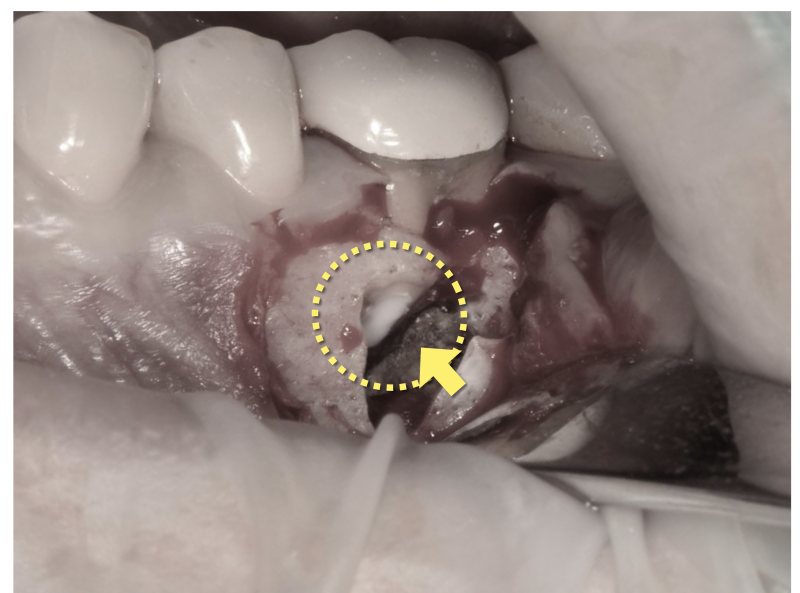
It's brutally hard, but once I've placed this white dot,
the painful memories of hunching over and nervously holding my breath vanish, as if by magic.
The reasons for doing root-end surgery are simple.
It saves the tooth,
and because it keeps the existing restoration in place, it costs less than replantation,
and recovery is fast: within two to three days, most patients can return to daily life and eat normally.
Especially when a tooth that recently had root canal treatment and a crown is brought up for extraction, the patient is shocked too,
and it's truly heartbreaking to look at the restoration that was painstakingly made.
Replantation means removing every restoration, and taking apart a recently placed crown is no easy decision either.
In this situation, if the restoration can stay intact and only the root problem is solved,
that's the best scenario for the patient, which is why I perform root-end surgery.
When something is difficult, I say so.
I can only perform one molar root-end surgery per day.
Yesterday afternoon, a lower molar root-end surgery was postponed due to the patient's circumstances,
and I wasn't tired at all until the end of clinic. I had plenty of time, and it was really nice.
Something many people get wrong: cutting off the root tip is covered by insurance,
but other approaches, such as tissue regeneration therapy and injection therapy, are not covered.
You may think it's expensive, but it's roughly what a root canal costs in some Southeast Asian countries,
so be grateful that you live in a country where this level of advanced treatment is available.
If you're struggling with tooth problems,
root-end surgery that keeps the existing restoration is the most certain and cleanest option, so I recommend it as the first choice.
If that isn't possible, option 2 is replantation.
If that doesn't work, consider wisdom tooth transplantation.
If none of these work, the remaining options are extraction or an implant.
Because it's the scenario most beneficial for the patient, I perform root-end surgery even though it's difficult and demanding.
That's all.
In Korea, implants have become the default treatment.
Saving a tooth is not an easy or simple treatment.
Also, once a tooth has passed a certain point, it can no longer be saved.
When multiple teeth are missing or several are loose, the tooth-saving treatment I do is difficult to apply.
I'd recommend thoroughly reviewing my blog and YouTube channel to see whether you qualify.
Dr. Choi Yong-hun clinic introduction video: https://www.youtube.com/watch?v=YCiCJLrG1J8
#RootEndSurgery #Apicoectomy #DrChoiYonghun #ToothPreservation
Frequently Asked Questions
When should root-end surgery be considered?
The author explains that if the root problem can be solved while keeping the existing restoration, root-end surgery is the top recommendation. If that's not feasible, the author says the options are considered in this order: replantation, wisdom tooth transplantation, extraction, or an implant.
How long does recovery take after root-end surgery?
According to the article, most patients can return to daily life and eat normally within two to three days. It notes that recovery is faster than replantation and also mentions that the existing restoration can be kept in place.
What matters most in preventing recurrence after root-end surgery?
The article explains that the most important thing is to thoroughly clean the contaminated root, create the necessary space, and then seal it completely so it never recurs. It also says several methods are combined to prevent inflammation from coming back and to promote alveolar bone regeneration.
Why is molar root-end surgery so difficult?
The article explains that access to molars is often difficult in the first place, and visibility is so limited that the surgeon must bend deeply to see. It also says that even slight bleeding can cause the material to degrade and lead to failure, so achieving a bloodless surgical field is not easy.
Is root-end surgery covered by insurance?
The article explains that apicoectomy, which involves cutting off the root tip, is covered by insurance, but tissue regeneration therapy and injection therapy are not. Since actual coverage may vary, it's best to confirm directly with the clinic before treatment.
Can teeth be saved if several are loose?
The article explains that when multiple teeth are missing or multiple teeth are loose, the tooth-saving treatment the author performs is difficult to apply. It also notes that a tooth cannot be saved once it passes a certain point, and recommends that readers thoroughly review the blog and videos to determine whether they qualify.