2026-11-18
Saving the Alveolar Bone Matters More Than Saving the Tooth #ToothReplantation #DrChoiYonghun
Explains why the alveolar bone matters more than saving the tooth itself, how tooth replantation works, and how a natural tooth helps bone regenerate without grafting.
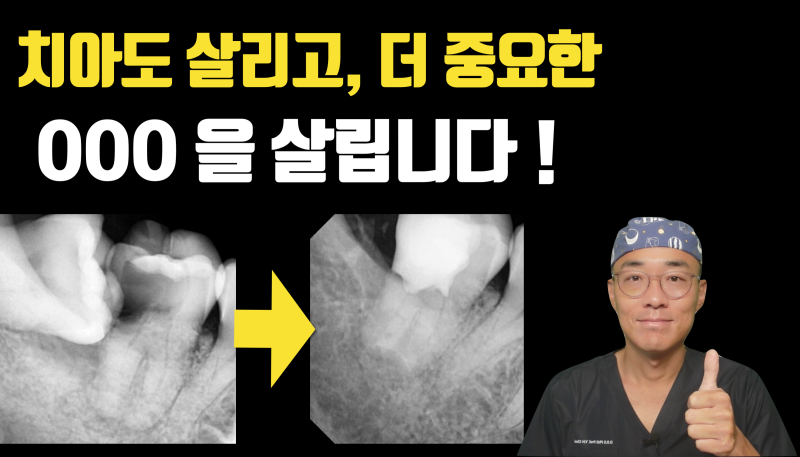
Most people only look at the tooth itself and argue over whether it can be saved or not.
Saving the tooth is an important issue, but beyond it there is an extremely important issue about regeneration that most people don't know about.
The most important thing for dental health is
the alveolar bone.
Many people worry about cavities,
but most cavities can be managed and resolved one way or another.
What matters most in saving a tooth is
whether the root remains,
and whether that root is healthy.
What holds and supports that root is
the alveolar bone.
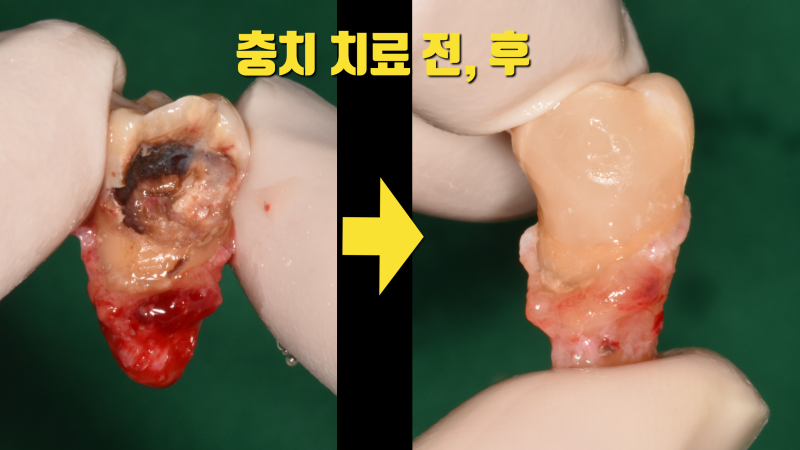
As the photo below shows, no matter how large a cavity is, it can be resolved easily.
Even a large, deep cavity that is difficult to treat inside the mouth
can be cleanly resolved within 10 minutes once the tooth is taken out of the mouth.
Even a tooth that has been recommended for extraction
can be cleanly treated outside the body through tooth replantation and then placed back in,
and as the periodontal ligament and alveolar bone reconnect,
the tooth can function well and stay sturdy.
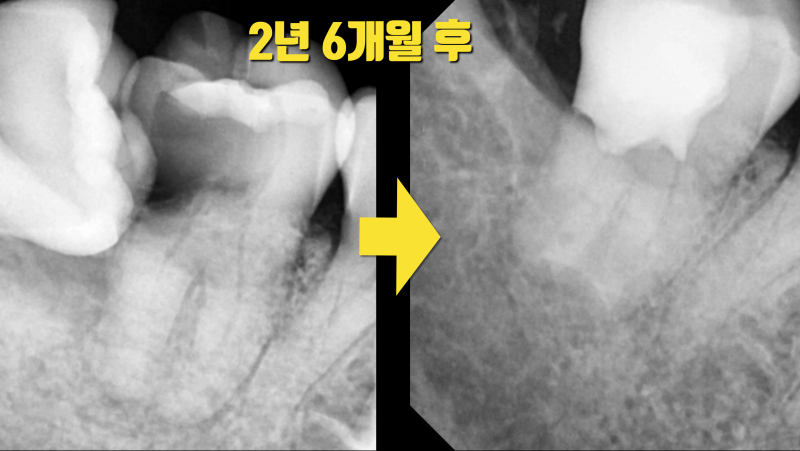
The wisdom tooth at the back that had been causing trouble no longer serves any purpose,
so it was resolved by extracting it during the replantation procedure.
Two years and six months later, the tooth has settled in well and is functioning properly.
What is even more important here is
that after saving the tooth in front of the wisdom tooth,
the alveolar bone in the back naturally regenerated.
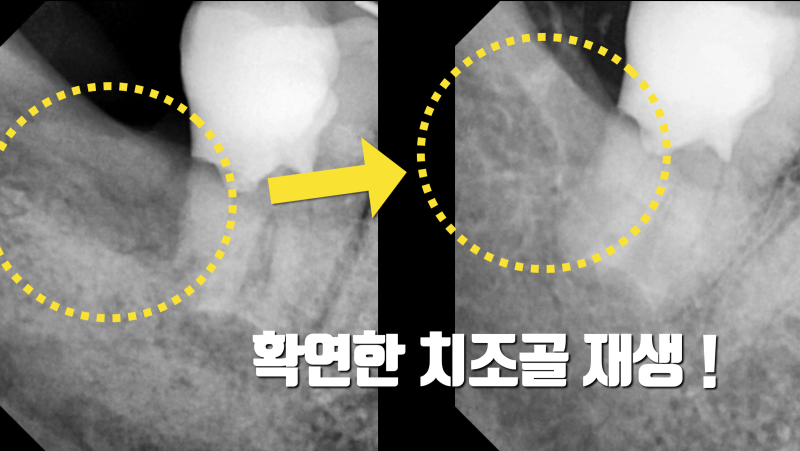
Even when a tooth is simply extracted, the alveolar bone regenerates to some degree,
but the bone that regenerates while the tooth is still present is incomparably greater and more certain.
To put it simply, think of putting up a tent or canopy:
just as a tent only rises high when there is a pole,
the tooth serves as the pole.
When the tooth acts as the support, the canopy (the alveolar bone) naturally rises to follow.
Just as a tall tent needs a long, sturdy pole,
a healthy tooth lets the alveolar bone grow up along the tooth's wall.
What you often hear at the dentist
is that your alveolar bone is insufficient, and so on.
On top of the high cost of rebuilding that bone,
it also takes an enormous amount of time.
And it isn't even natural bone. It has to be built with great difficulty by grafting artificial bone.
If you keep your natural tooth, natural alveolar bone forms on its own without any bone grafting.
If you don't know about a natural tooth with this regenerative capacity and pull it out easily,
only the person who lost the tooth ends up losing.
After all, the one who loses the tooth is only the patient who had it pulled.
For the dentist, pulling a tooth is quick, easy, and simple, so it's convenient,
and everyone else doesn't care at all whether you pull the tooth or plant a stone in its place.
You have to protect your own body parts yourself.
Who on earth is going to protect my body for me?
After making the effort to come all the way to our clinic,
when I see patients give up on their own body parts for one reason or another,
it's heartbreaking as a human being,
but we never recommend treatment or reach out to them again.
They are all adults who say they will do as they wish with their own bodies and take responsibility for the outcome,
so our principle is not to interfere in other people's lives.
My head sticks to this policy,
but in my heart, I still hope no one ends up pulling out a tooth simply because they didn't know better,
which is why I also run a YouTube channel and a blog.
It's been a while since I wrote such a long post,
but I think if you've read this far, you know what I'm trying to say.
I also turned this long piece into a video, so please watch it,
and subscribing and liking is love!
Our clinic mainly performs high-difficulty tooth replantation for teeth that have been recommended for extraction.
Dr. Choi Yong-hun's replantation success rate is 100%.
We do not offer any implant-related consultations or treatments.
#ToothReplantation #CrackedTooth #FracturedTooth #DrChoiYonghun #SaveYourTooth #BondedCeramic
Frequently Asked Questions
What is tooth replantation?
The article explains that tooth replantation is a method in which a tooth recommended for extraction is treated outside the mouth and then placed back in. It notes that once reinserted, the periodontal ligament and alveolar bone reconnect, allowing the tooth to function properly.
Why is the alveolar bone important?
The article states that the alveolar bone is the most important factor for dental health. It holds and supports the tooth's roots, and when it comes to saving a tooth, it says that whether the root remains and whether that root is healthy are what matter.
Can a tooth with a deep cavity still be saved?
The author explains that even a large, deep cavity that is hard to treat inside the mouth can be resolved by taking the tooth out and treating it outside the body. The article's position is that most cavities can be resolved.
What happens to the alveolar bone after extraction?
The article explains that even after extraction, the alveolar bone regenerates to some extent, but far more regenerates when the tooth is kept in place. It compares the tooth to the pole of a tent: when the tooth serves as a support, the alveolar bone rises to follow.
What if the alveolar bone is insufficient?
The article mentions that when alveolar bone is insufficient, it can be built by grafting artificial bone, a process that it says costs a lot of money and time. By contrast, it says that if the natural tooth is kept, natural alveolar bone forms on its own without bone grafting.
What is the success rate of tooth replantation?
The article states that Dr. Choi Yong-hun's tooth replantation success rate is 100%. However, this figure appears in the clinic's own post, and the article does not specify how it was calculated or where it came from.