2026-11-01
Explaining Why I Don't Do Digital Dental Prosthetics #ToothPreservation #DrChoiYonghun
Dr. Choi Yong-hun explains why he still handcrafts ceramics for tooth-preserving designs instead of digital prosthetics, which laser scanners can't capture accurately.
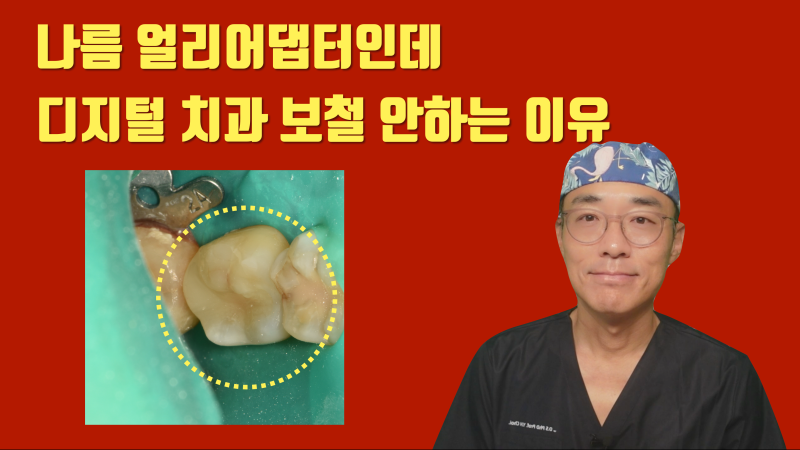
In practice, I sometimes find it harder to deal with patients who know a lot than with those who know nothing.
For example, it can be easier to teach someone who has never played tennis at all than to correct someone who learned sloppily from the older guys in the neighborhood.
Sometimes it really is easier.
A few days ago, a patient came in and asked me so many questions, like why I didn't do this one this way and why I did that one that way.
I explained the reasons for each one, but to be honest, it was exhausting.
For laypeople with no basic knowledge of dentistry,
I'll just say that many parts are hard to understand.
I usually tell patients that I try to avoid root canal treatment and crowns whenever possible...
Digital dentistry, which is the trend these days, is surprisingly simple.
Rather than taking an impression of the tooth with a rubber-like material,
a dental laser scanner scans the tooth surface, and the data is used either to mill the tooth on a computer or to create its shape with a 3D printer.
This is called digital dental prosthetics.
Setting aside the cost of equipment, digital prosthetics will become the mainstream going forward, and many clinics already use this method.
For reference, a few days ago I had dinner with the director of the dental hospital that was the first in Korea to start digital prosthetics and still does the most of them.
We had dinner together.
We share similar goals and often think alike, so I always feel good when we meet.
Do you think I couldn't do digital dentistry if I really wanted to?
Since they're good for treatment, I have four French-made anesthesia devices, which most others find hard to buy even one of.
Not satisfied with that, I'm thinking about buying one more...
As with anything, there are pros and cons.
Digital is fast and accurate, and it's great in many ways,
and it's definitely better for laminates and crowns.
However,
the treatment I do involves complex tooth preparation to save as much of the tooth as possible,
so the shapes become unusual.
That makes it difficult for a laser scanner to accurately scan every nook and corner.
You might think a laser is accurate for everything, and it is accurate for laminates and crowns,
but digital is not suitable for the tooth-preserving designs I do,
so together with the technician I've worked with since my days at Seoul National University Bundang Hospital, I make each ceramic piece by hand.
This technician also has all the equipment for making teeth digitally,
but says that handwork is better for the treatment I do, so the two of us keep making every ceramic piece by hand, which can feel a little lonely.
If laser scanning technology advances enough that even the prosthetics I make can be scanned accurately,
and digital can match the precision of handwork, then of course I will switch to digital too.
However, for now digital can't keep up with our method and produces errors,
so we're using the analog method.
For reference, all the ceramics I make are produced with just one technician,
so it takes a long time from taking the impression to placing the restoration. I apologize for the wait and appreciate your understanding.
To be clear, I'm not sticking with analog because I'm behind the times; I'm insisting on it because the technology can't keep up.
That's all.
In Korea, implants are a routine treatment.
Tooth preservation without root canal treatment is not a simple or easy treatment.
Also, once a tooth crosses a certain threshold, it cannot be saved.
Cases with multiple missing teeth or multiple loose teeth make tooth preservation as I practice it difficult.
I'd recommend that you watch my blog and YouTube channel thoroughly and check whether you fall into these categories.
Introduction video of Dr. Choi Yong-hun's treatment: https://www.youtube.com/watch?v=YCiCJLrG1J8
#CrackedTooth #Reattachment #ToothReattachment #FracturedToothReattachment #PeriodontalDiseaseReattachment #DrChoiYonghun #ToothPreservation
Frequently Asked Questions
What is digital dental prosthetics?
Digital dental prosthetics refers to a method in which a dental laser scanner scans the tooth surface, and the tooth is then milled on a computer or its shape is created with a 3D printer. Its defining feature is that no rubber-like impression material is used to take a mold of the tooth.
Is digital prosthetics suitable for all treatments?
No, it depends on the type of treatment. Digital is definitely better for laminates and crowns, but the author says it is not suitable for tooth-preserving designs that involve complex tooth preparation to retain as much of the natural tooth as possible.
Why is it difficult to produce tooth-preserving designs digitally?
The author explains that because the teeth are complexly prepared, resulting in unusual shapes, a laser scanner has difficulty accurately scanning every nook and corner. For now, ceramics are handmade together with one technician, and the author stated that they plan to switch to digital once scanning technology advances.
Does handmade ceramic take a long time from impression to placement?
Yes, the clinic notes that it takes a long time from taking the impression to bonding the restoration. The reason given is that all ceramics are made with just one technician, and the clinic asked for patients' understanding on this point.
Is tooth preservation possible if multiple teeth are missing or loose?
The article explains that tooth preservation is difficult when multiple teeth are missing or multiple teeth are loose. It also notes that once a tooth passes a certain threshold, it cannot be saved, and it recommends checking the blog and YouTube channel to see whether you fall into these categories.