2026-11-03
[Natural Teeth That Last] Introducing an 11-Year Follow-Up Case of Front Tooth Replantation #Replantation #SaveYourTooth #DrChoiYonghun
Dr. Choi Yong-hun shares an 11-year follow-up on a front tooth replantation in a patient in her early 30s, arguing that saving a natural tooth comes before choosing an implant.
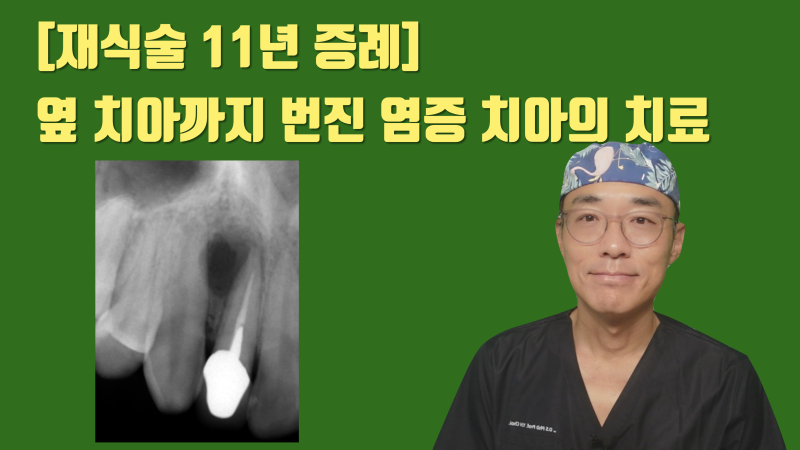
Tooth replantation, the procedure of extracting a tooth and saving it by placing it back, isn't a treatment I created.
It's a treatment that appears in every textbook, yet oddly enough, I'm the one who gets targeted and caught up in controversy, which is ironic.
Especially in Korea, implants have come to be perceived as a miraculous relief pitcher coming in to save the game.
Most people think they have to choose one or the other: a natural tooth or an implant.
Understanding this phenomenon requires understanding the painful history Korea has endured over the past 100 years.
We had to choose between Japan or Qing China and Russia. (Whichever it was, it was still colonization; the only question was which one to attach ourselves to.)
When the June 25th War broke out, we had to choose between South and North.
In politics, people are split into left and right and fighting like crazy.
We're divided into Gangnam and Gangbuk.
We're divided into men and women.
We're divided into the provinces and Seoul, and we live under pressure to quickly pick one of the two: "Which is better?" That's the reality of our lives.
As for politics or real estate, I don't really know much about those...
Even when a tooth looks seriously damaged, if there's any possibility, we try to save it.
The idea is to use it for as long as possible, and only if that still doesn't work out, get an implant at that point.
I'd guess that about 80% of people reading this post are running the same mental loop: "Is a natural tooth better, or is an implant better?"
I understand it, since being forced into choices like this seems to be written into the DNA of Koreans.
I have an implant myself. Before that, I used that tooth well for about 12 years.
When there was truly no other way, I had it extracted and got an implant.
I have no regrets, and I'm very satisfied.
Back when there was no treatment at all for a cracked tooth, I saved it and it functioned for 12 years. That's enough, isn't it?
A female patient in her early 30s came in for an infection in her front tooth.
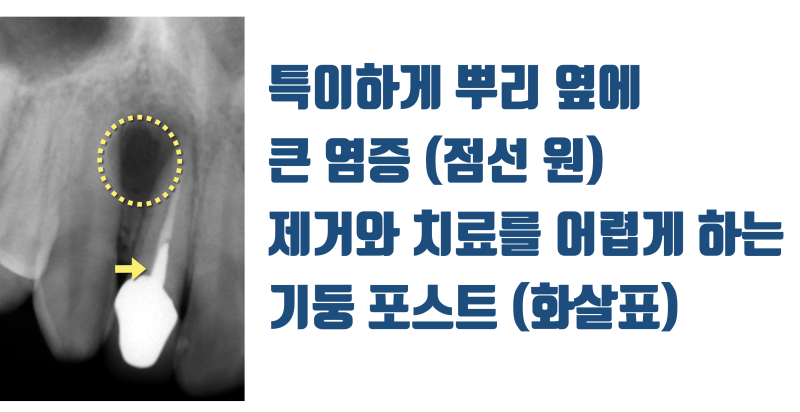
First of all, the infection was large.
More importantly, its location was bad. It had spread to the neighboring canine, so the situation was somewhat dangerous.
On top of that, I honestly don't understand why anyone would put a post into a front tooth like this.
A post had been embedded in the front tooth, so it was truly a no-win situation: it couldn't be pulled out, and it couldn't be left as it was.
I'd like to point out one thing here: as a general rule, it's best to avoid implants for front teeth.
Many Koreans have protruding mouths, and as a result, their alveolar bone is thin.
In quite a lot of cases, there isn't enough alveolar bone to cover an implant.
So if you really must get an implant, be sure to have a front-tooth implant placed by an experienced dentist with excellent skill.
But before that, if a front tooth can be saved, of course you should try to save it first. That's the proper order.
It's not an either-or choice; it's a sequence.
It's not like deciding whether to go to elementary school or middle school.
You graduate from elementary school and then go on to middle school.
We're forced to decide everything.
In a Korean society built to split people into "my side" and "your side" and set them against each other, that mindset has spread even to dental problems.
It's sad that we're now pressured to decide right away: a tooth or an implant?
Considering the location of the inflammation and the post, I performed replantation.
To be honest, the treatment for this tooth is about as old-school as it gets.
It was 11 years ago, before I went to Japan, so the materials used are ones I don't use at all now.
On top of that, it was done in an era when there wasn't even a dedicated storage solution for teeth, the most important factor.
Even so, if you stay faithful to the basic principles, the results are good.
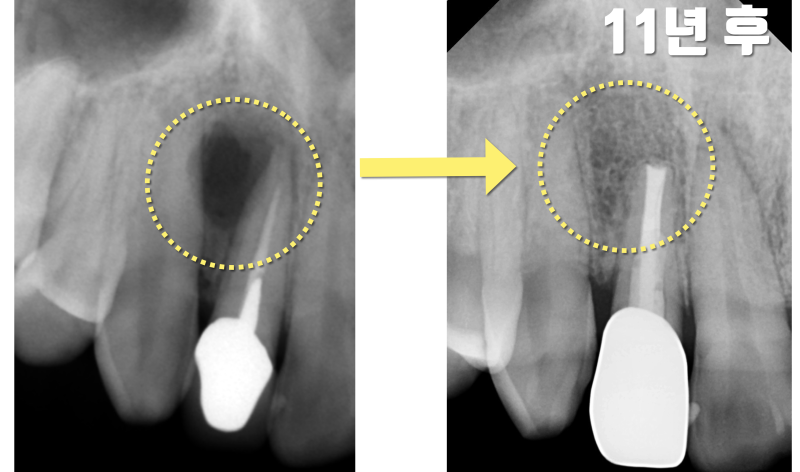
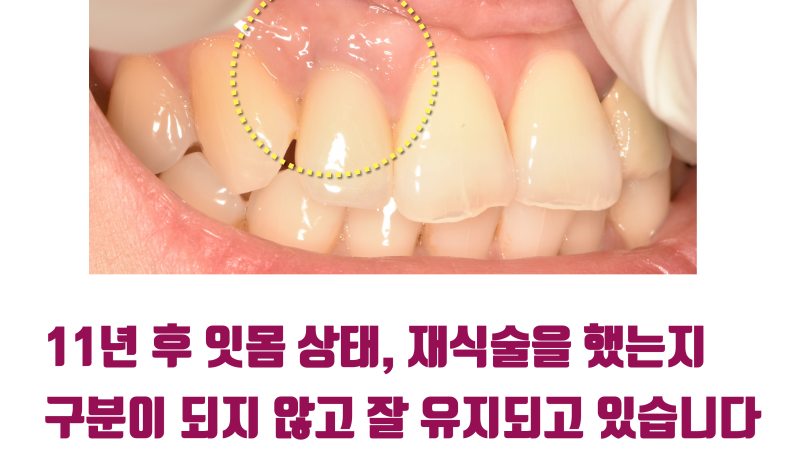
The large infection that had taken hold has completely disappeared, and even after 11 years, the tooth is in excellent condition.
The reason this patient came back to see me after 11 years was to have a different tooth treated. This tooth had no problems at all.
People who have no idea what replantation is or how it's done heap curses on it, saying a saved tooth won't last long.
When it's treated well, the tooth and gums stay so healthy that they're visually indistinguishable from the surrounding teeth.
Of course, how skilled I am at performing the treatment matters too.
But the core principle of this treatment is making good use of the characteristics of the human body, in particular the inherent properties that teeth possess.
I often feel sad for Koreans who throw away opportunities like this and get pressured to hurry up and decide between a tooth and an implant.
In this respect, the patient's way of thinking matters too.
If you have even the slightest doubt, and you'd find more peace of mind simply by having the tooth extracted, please don't come in for this kind of treatment.
Every treatment carries the possibility of failure.
And having a problem with your own teeth isn't something to brag about, nor does it give you any special rights.
During consultations, I often hear things like:
"Doctor, please save it. If there's any chance at all, I really want to try."
Over 90% of patients say something like that, but there are some who come at me aggressively with, "What are you going to do if you can't save it?"
Sometimes people seem to mix up who the one drowning here actually is.
The patient is the one begging me to save it (I'm not saying I'm the one throwing my weight around), bringing in a tooth that's borderline even worth asking to save.
If I can't save it, or if anything goes wrong even slightly, they threaten me, saying something like, "Choi Yong-hun, I won't let you off the hook."
So I suggest they think it over and send them away.
Saving a tooth is a choice, not a treatment you're obligated to get no matter what.
Under no circumstances do I recommend treatment to a patient who isn't willing.
That's all.
In Korea, implants are the standard treatment.
Saving a tooth without root canal treatment is not an easy or simple procedure.
Also, once a tooth crosses a certain threshold, it can no longer be saved.
Cases with multiple missing teeth or multiple loose teeth make the tooth-saving treatment I perform difficult.
I'd recommend reviewing my blog and YouTube channel thoroughly to see whether you fall into this category.
Dr. Choi Yong-hun's clinic introduction video: https://www.youtube.com/watch?v=YCiCJLrG1J8
#CrackedTooth #Replantation #ToothReplantation #FracturedToothReplantation #PeriodontalDiseaseReplantation #DrChoiYonghun #SaveYourTooth
Frequently Asked Questions
What is replantation?
Replantation is a treatment that saves a tooth by extracting it and then placing it back. The author explains that it is a method found in textbooks and says it is applied after considering the location of the infection and the post embedded in the tooth.
Should a front tooth be saved before getting an implant?
Yes. The author explains that if a front tooth can be saved, trying to save it comes first, before an implant. Many Koreans have protruding mouths, so their alveolar bone is thin, and there is often not enough bone to cover an implant. The author adds that if an implant is necessary, it should be placed by a dentist with sufficient experience and skill.
How long does a tooth last after replantation?
In one case the author presented, the tooth was still in excellent condition 11 years after replantation. In the same case, the infection had completely disappeared. The author also noted that every treatment carries the possibility of failure.
Can everyone have their tooth saved?
It isn't a treatment that works in every case. The author explains that saving teeth is difficult when multiple teeth are missing or loose, and that once a tooth crosses a certain threshold, it can no longer be saved. The author's stance is not to recommend it to patients who are unwilling to undergo it.
Is saving a tooth an easy treatment?
No. The author explains that it is not an easy or simple treatment. Stressing that saving a tooth is a choice rather than an obligation, the author advises readers to thoroughly review the blog and YouTube materials to determine whether they qualify.