2026-09-22
A Large Cavity Does Not Always Mean You Need a Root Canal
A large cavity does not always require a root canal. If properly diagnosed as reversible pulpitis, natural teeth and nerves can be preserved with pulp protection therapy.
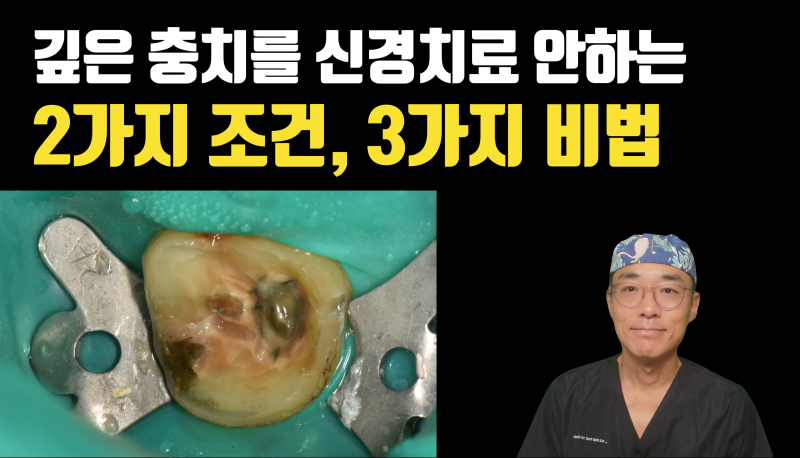
It is completely natural for patients not to know the precise state of their teeth.
However, one of the most critical principles taught in dental school
is distinguishing between reversible pulpitis and irreversible pulpitis.
If only a single question could be asked on the dental licensing exam,
I can say with confidence,
it would be: "Compare and contrast reversible pulpitis and irreversible pulpitis."
Telling these two apart is the absolute foundation of dentistry—
an unshakeable principle as distinct as north and south, or positive and negative.
The reason this is so crucial is that
the diagnosis directly dictates the treatment method,
and it completely changes the outcome of the treatment.
Yet, despite such a clear and fundamental criterion,
there seem to be cases where patients are told they need a root canal simply because the cavity is "large" (even though "large" or "small" lacks objective criteria and is subjective to begin with...).
Even if a cavity is large, root canal treatment is not necessary as long as the condition is reversible pulpitis.
Conversely, even if a cavity is small, a root canal is necessary if it has progressed to irreversible pulpitis.
This is the fundamental law of dentistry and the basis of proper dental care.
By evaluating both X-rays and clinical symptoms comprehensively,
if it is identified as reversible pulpitis, the tooth does not require a root canal.
In this context,
do not wait until the tooth reaches the borderline between reversible and irreversible before finally heading to the clinic in frustration.
(Once a tooth is right on the brink of irreversible pulpitis, making an accurate diagnosis becomes extremely difficult.)
Treating it early with proper pulp protection therapy and bonded ceramic restorations
is the best outcome for both the patient and the dentist.
When a case is borderline, I always inform the patient about the potential need for root canal therapy or intentional tooth replantation before proceeding.
Just as cramming with a star tutor the night before the college entrance exam is futile,
the best approach is to get accurate, definitive treatment early on while reversible pulpitis is still certain.
Our clinic specializes primarily in saving compromised teeth that have been recommended for extraction.
We do not provide implant consultations or implant treatments.
Please note that we do not offer routine dental checkups or basic dental care. We appreciate your understanding.
#ToothReplantation #CrackedTooth #FracturedTooth #DrChoiYongHoon #SavingTeeth #BondedCeramic
Frequently Asked Questions
Does a large cavity always require a root canal?
No, a large cavity does not automatically mean a root canal is required. If a comprehensive evaluation of X-rays and symptoms indicates reversible pulpitis, the natural tooth and its nerve can be preserved through pulp protection treatment without undergoing a root canal.
Can a small cavity ever require a root canal?
Yes, even a small cavity may require root canal therapy. If the inflammation has advanced to irreversible pulpitis, a root canal is necessary regardless of how small the cavity may appear on the surface.
What treatment is performed for reversible pulpitis?
Pulp protection therapy and bonded ceramic restorations can be performed. When treated definitively during the early stage where reversible pulpitis is clear, the nerve can be preserved with targeted protection and ceramic restoration.
Why is it important to seek treatment early rather than postponing it?
Because holding off until the condition reaches the threshold of irreversible pulpitis makes diagnosis and treatment significantly harder. Right before becoming irreversible, evaluating the pulp vitality is tricky, and the likelihood of needing a root canal or intentional replantation increases dramatically. Early intervention is essential.