2026-11-04
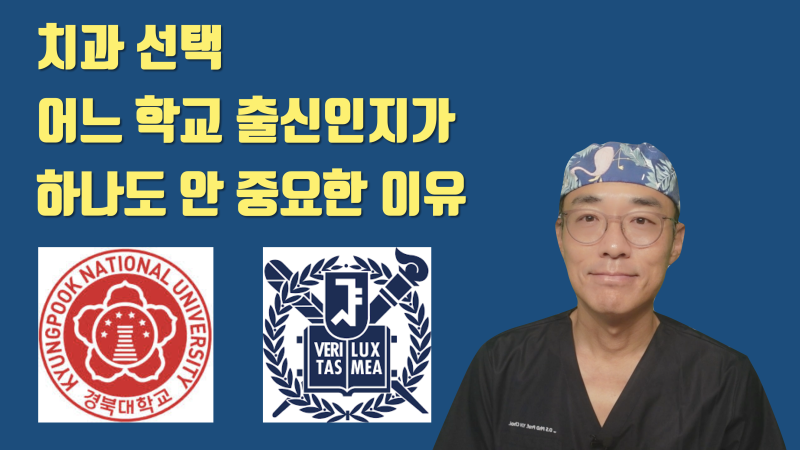
[Choosing a Dentist] Does It Really Matter Which University a Dentist Graduated From?
Dr. Choi Yong-hoon argues that a dentist's alma mater says little about skill; hands-on experience and deep expertise in a specific field matter far more.
Rather than which specialist certifications a dentist holds, which field they have developed real expertise in and how deeply they practice it
is far more important and has a much greater impact on your oral health, as I've said before.
Since I'm already on this topic, I'll ride the momentum and lay it all out for you.
Once you know it, it's a simple and obvious point if you just stop to think about it,
but given how easily Korea gets swayed by the name on that signboard, I'd ask you to consider it at least once.
At this point, you might say,
'Dr. Choi, aren't you only saying this because you didn't go to SNU and you're consumed by self-consciousness and inferiority?' I can see why some of you might ask that, but
I graduated from Kyungpook National University School of Dentistry,
then completed my master's and doctoral programs at Seoul National University School of Dentistry,
and spent about 15 years as a professor in the Department of Conservative Dentistry at Seoul National University Bundang Hospital.
I earned my graduate degrees at SNU, but no one calls me an SNU graduate,
and I don't consider myself an SNU graduate either. It doesn't bother me at all, and I feel nothing about it.
Watching the strange culture among them, where you only count as an SNU person if you did your undergraduate degree there,
I couldn't help wondering if they were living in the Joseon era. In any case, I have no interest in getting involved in their own little league and their pride.
I'm proud to be a Kyungpook National University School of Dentistry graduate, and I've never once hidden it or avoided it.
If you visit my clinic, you'll see a large Kyungpook National University emblem displayed prominently.
Even when I was a professor at SNU Bundang, whenever patients asked if I was an SNU graduate, I immediately told them I wasn't.
It's true that certain universities have higher admission scores than others.
It's also true that their high school GPAs and College Scholastic Ability Test (CSAT) scores are high.
And it's true that ranking them this way creates a pecking order.
But after graduating from dental school, is there really any difference between a graduate of one school and a graduate of another?
The medical knowledge a dentist needs consists of subjects you never studied in high school,
and the manual skills that matter most for a dentist are something no one considers when entering dental school.
Also, the purpose of dental school is to get graduates through the national dental licensing exam so they can become dentists.
No dental school teaches anything special or bizarre.
If anything, trying something odd is more likely to make students fail the licensing exam and end up unable to function in society.
So although there are several dental schools, their curricula and teaching content are nearly identical, all to get students through the national dental licensing exam.
It's like students from different high schools using similar textbooks and taking the same mock exams, then comparing their scores.
And ultimately, does knowing a lot make someone good at treatment?
Dentistry is a profession that expresses the knowledge and know-how in your head through your hands.
No matter how much you know, if you can't put it into practice with your hands, that's the end of it.
But manual skill isn't something one school can teach you better than another.
The only way to develop it is through painstaking effort, practice, and relentless training.
So clinical technique depends on each person's ability and talent, and no particular university teaches it especially well.
And they can't do that, either.
If you've followed this far, I think it makes sense,
but the bigger problem is only just beginning.
In many areas, dental school education falls far behind the latest dental techniques.
The latest technologies, materials, and treatment concepts are changing by the day,
but universities have no choice but to focus on what's in textbooks and on the national exam, and that's part of the reason.
I have plenty to say about the stagnant curriculum, too, but I'll stop here, or they'll come swarming in.
A prime example is dental amalgam, which contains mercury and which the government now advises against using.
Yet there's a school that spends not just one hour, but an entire semester, teaching amalgam.
I was shocked when I heard it, but I'm told it's true.
Even worse, there's an outdated rule requiring you to perform a certain number of amalgam procedures to become a board-certified specialist in conservative dentistry.
Here's why I call it outdated.
A resident I taught had to do amalgam procedures because of this rule,
but Seoul National University Bundang Hospital officially prohibits bringing mercury into the hospital.
Because of infection control, amalgam can't be placed there, yet dental schools and academic societies keep telling dentists to do it.
That is the current system for training dentists.
While we're on the subject,
I earned my PhD based on a clinical follow-up report on intentional tooth replantation.
When I presented the thesis summary, it was literally chaos.
Some professors shouted that I was practicing nonsense and walked out.
The atmosphere became so hostile, it felt like they wanted to tear me apart.
The irony is that tooth replantation is a treatment found in textbooks,
and I only did what the textbooks describe.
Even funnier, to become a board-certified specialist in conservative dentistry, you actually have to perform at least three tooth replantations in practice!
Despite that, they rejected it simply because they didn't understand it, and they took the lead in blocking the growth of a new field.
That's the current state of dental education in Korea.
What's truly absurd is that the procedures I perform are all in textbooks,
and even taught to students in class as treatment methods.
Yet because I performed them systematically and in volume, I got every insult imaginable and was publicly humiliated.
The real joke is that a few years later, some of the professors who had piled on at the time quietly published papers on replantation themselves.
I'm speechless...
I'm not trying to bash any school, though.
What I'm saying is that dental schools still can't keep up with the treatment techniques and latest methods available on the market.
That's right...
So wouldn't it be better to learn under a certain professor?
That's half right and half wrong. If a professor sincerely and generously passes on their own clinical skills, then it could be,
but if it's a bad professor who keeps residents on a string, dangling the prospect of teaching while working them like slaves, that's a different story.
I've personally seen professors who put residents through all sorts of tasks with the false hope of 'I'll teach you someday,' so I'd say it's fifty-fifty.
And this is a completely different question from which university you graduated from, right?
It's about who you learned from, so it has nothing to do with your alma mater.
So, to conclude: which university you graduated from may create a sense of familiarity or comfort,
but in my view, it has almost no correlation with a dentist's expertise or clinical skill.
Most of the treatment techniques I use today were learned on my own and in Japan. That's all there is to it.
As far as I know, dental schools still teach very basic, theory-focused tooth preservation techniques.
Because not a single professor has ever come to me to ask about these.
This post got long, but the conclusion is simple.
Find the expert in that field. That's the bottom line. Look into that person's expertise, then decide whether to entrust your teeth to them.
Judging someone as skilled based on a school crest and imagination alone is very likely to be a wrong guess.
Dental treatment isn't done with the head; it's a technical treatment carried out by hand.
What matters is how much of that procedure someone has actually done and how deeply they've studied it. A university crest means nothing.
There's a saying passed down in the dental community.
Whatever the procedure, the one who has done it the most is the real deal and a true master!
That's all.
In Korea, implants have become the default treatment.
Preserving a tooth without root canal treatment is not an easy or simple procedure.
Also, once a tooth has been damaged beyond a certain point, it can no longer be saved.
Cases with multiple missing teeth or multiple loose teeth make my tooth-preservation approach difficult.
I'd recommend browsing my blog and YouTube channel thoroughly and checking whether your case applies.
Dr. Choi Yong-hoon Clinic Introduction Video: https://www.youtube.com/watch?v=YCiCJLrG1J8
#Crechia #Replantation #ToothReplantation #FracturedToothReplantation #PeriodontalDiseaseReplantation #DrChoiYonghoon #ToothPreservation